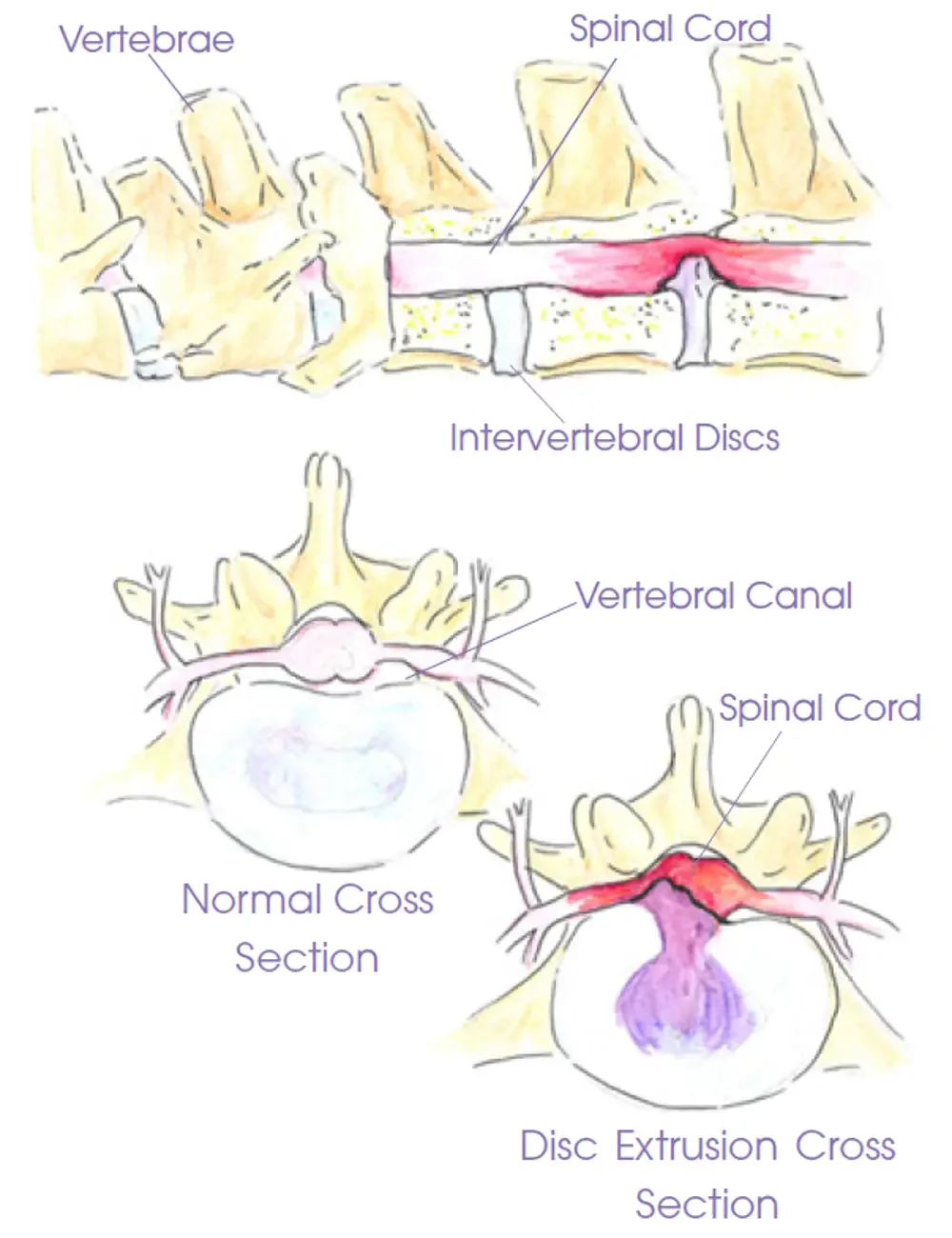
What is IVDD?
IVDD stands for intervertebral disk disease, put simply it's a condition where the spinal disks bulge or burst. Like many other professionals I think of these discs as jam donuts! The jam can either burst out or the donut can dishape and push out of their assigned space. Back to discs! These discs act as shock absorbers between the spinal vertebrae so when they burst and bulge, they press on the spinal cord which causes pain and disrupts nerve signals which can lead to the characteristic wobblyness and paralysis.
Why are dachshunds predisposed?
Roughly 1 in 4 dachshunds are affected which is largely due to genetic predisposition. Dachshunds have been bred for long backs and short legs which we describe as a chondrodysplasic body shape, which puts more pressure on the discs during daily activities. This genetic trait also causes the spinal discs to harden/calcify prematurely which makes them brittle and susceptible to rupture.
Signs to watch out for…
Unwilling to jump/run/walk/stairs or do normal daily activities, a hunched back, yelping when touched, weakness in the hindlimbs, dragging paws, wobblyness and paralysis. I've specifically ordered them this way with the first being the more mild signs that we may see in the earlier grades, and the last being the more dramatic/severe we see in later grades. I’d always recommend a vet visit if you are worried about anything because they can do specific tests and images to confirm.
How can we decrease the likelihood/possibility?
We can do some simple home changes or adaptations that take the pressure off the spine through the house. I recommend these changes in most of my patients, not just the sausages, so ill just keep it short now and just pick the big ones. Cutting out steps and jumping off sofas/beds/cars and instead adding ramps and stools, this stops the jumping, twisting, fall risks and concussive forces that go through the front legs and down the spine. I will also always recommend a well fitted harness over a collar as this takes the direct pressure of the spinal cord and neck and distributes it over the chest and shoulders. We can also work on strength work similar to human and canine athletes doing conditioning training to prevent injury, this prehab comes before diagnosis and the following rehab. When we build spinal muscle mass, we are adding an extra layer of support and protection to these discs. Though these things won’t eliminate the risk, it sets us up for anything that could happen in the future.
A quick look into some rehabilitation exercises focusing on the spine:
I use these commonly with many of my patients but these few are especially good for IVDD as they focus on the spine/weakness and can be adapted for different severities.
Weight shifting - can be used to re-educate the nerve pathways as the muscles react to our manual movements and stabilise as necessary, improving posture.. This is good for our early stages of rehab as we are moving for them keeping the spine neutral, while passively increasing limb loading. We can do this sideways and forwards/backwards dispensing on what we want to target. So to go sideways i put one hand on each hip and gently push to either side in a rocking motion. To go forwards and back I can either put my hands on the chest/shoulders and pull back or grip the front of the back legs around the quads and rock backwards again.
Raised forelimbs - just on a book or yoga block to start with. So again this is increasing the hindlimb loading but independently this time by engaging the muscles and maintaining the posture through core and spinal stability. This is generally a well received exercise as working with a likimatt helps focus and stay cooperative.
Give paw - is generally known by a lot of dogs but i prefer to ask for this from a standing position as we get more out of it. This is a more advanced exercise than the last 2 as this time we are actively asking to load certain limbs, which involves using the core to stabilise and balance. Weight shifts diagonally, so giving the right front paw will transfer weight to the back left paw, so we can also use this to highlight any asymmetries or weaknesses between left and right.
Lateral baited stretches - also known as cookie stretches or carrot stretches. This is the most complex exercise out of my examples, that would be used at later stages when the dog shows no signs of wobbles and can support themselves. It encourages spinal flexibility and range of motion, it dynamically strengthens core leading to better balance as well as releases tension build up due to stiffness and inactivity. This one is also harder to train as we only want to stretch as far as they can manage before they step out of it or try to circle. This is another reason why I'd say prehab is an important step, the dog will know what is expected of them so they will get less frustrated and focus, as well as making it a little easier on owners at what is probably a very stressful time with a lot going on already.